Asylum Fee Implications and Compliance
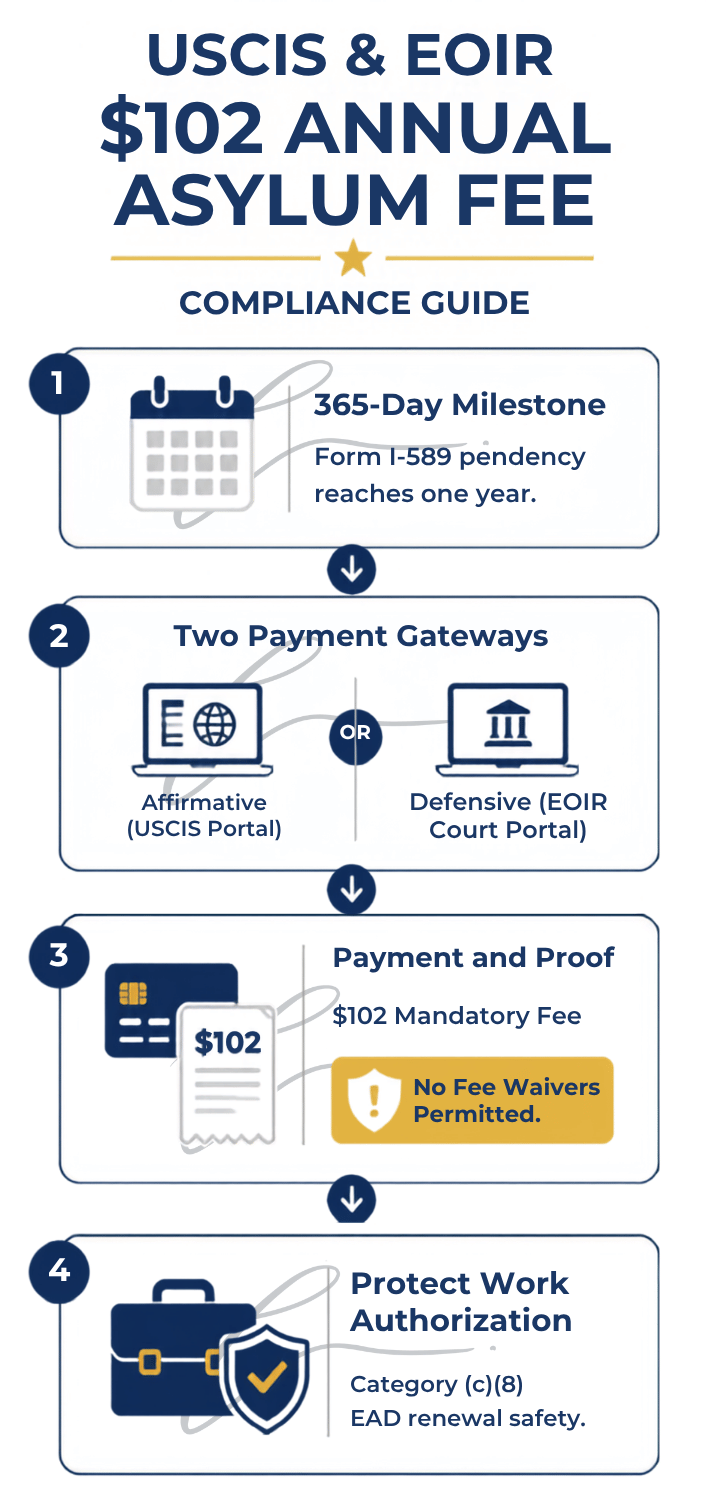
The annual asylum fee is a recurring federal charge required to maintain a pending Form I-589, Application for Asylum and for Withholding of Removal. Under statutory fee adjustments enacted through H.R. 1 and agency regulations, U.S. Citizenship and Immigration Services (USCIS) and the Executive Office for Immigration Review (EOIR) adjusted the Annual Asylum Application Fee (AAF) from $100 to $102 for Fiscal Year 2026 (USCIS Newsroom). For asylum seekers navigating historic agency backlogs, this policy transforms an open asylum claim into an ongoing annual compliance obligation. Understanding fee applicability, tracking deadlines, paying through the correct government portal, and archiving proof of payment are essential to protect your legal status.
Because fee rules have evolved through administrative regulations and federal court litigation, this guide provides vital legal information. If your deadline has passed, your work authorization is at risk, or your case is before an immigration court, contact qualified counsel immediately. At Lunel Law, founding attorney David Lunel and our legal team represent asylum seekers before the USCIS Atlanta Asylum Office, regional immigration courts, and appellate bodies nationwide.
Table of Contents
Overview of the Annual Fee
The primary operational shift under the Annual Asylum Application Fee is that a pending asylum claim is no longer a one-time filing step. Federal law now treats open asylum filings as recurring annual obligations. As announced by USCIS and EOIR, the fee was initially set at $100 and indexed to $102 to reflect inflation (Immigrant Legal Resource Center). The statute mandates this payment for each year an affirmative or defensive application remains pending without a final resolution.
This recurring charge creates acute vulnerabilities because asylum cases often remain pending for years. Even a modest fee can cause severe hardship when payment deadlines are tight, notices are misdirected by mail, applicants face financial distress, or jurisdiction transfers between agencies. Defaulting on payment can trigger application abandonment, work authorization termination, and deportation proceedings. While federal court challenges have temporarily enjoined specific penalty provisions under interim final rules, the government continues to assess the fee across official portals. The safest approach is to treat the annual charge as an indispensable compliance requirement.
Key Implications at a Glance
The table below summarizes the core structural rules and legal consequences of the $102 annual fee:
| Regulatory Feature | USCIS Affirmative Asylum Cases | EOIR Defensive Court Cases |
|---|---|---|
| Applicable Fee | $102 per application (adjusted annually) | $102 per application (EOIR Forms and Fees) |
| Governing Authority | Statutory budget rules and INA fee mandates | EOIR Policy Memorandum 26-01 |
| Pendency Threshold | Form I-589 pending 365 days or longer | Form I-589 pending 365 days or longer |
| Family Filings | Single $102 fee covers entire Form I-589 | Single $102 fee covers entire Form I-589 |
| Designated Gateway | USCIS Annual Fee Portal | EOIR Payment Portal |
| Standard Deadline | 30 days from issuance date on notice | Set by written order of Immigration Judge |
| Fee Waiver Policy | Strictly prohibited by statute | Strictly prohibited; no waiver permitted |
| Default Penalty | Application rejection and EAD revocation | Case dismissal and possible removal order |
Scope and Timing of Payment
The $102 fee applies broadly to noncitizens whose asylum cases have crossed the one-year mark. DHS and DOJ interpret “remains pending” expansively to include all Form I-589 applications pending before USCIS, immigration courts, or the Board of Immigration Appeals (BIA) without a final grant or dismissal (Immigrant Legal Resource Center).
For applications filed on or before October 1, 2024, that remained pending on September 30, 2025, the initial fee applied under the FY 2025 rollout. For applications filed after October 1, 2024, the fee becomes due 365 days after the filing receipt date and recurs annually on that anniversary. Importantly, the fee is assessed per Form I-589 application rather than per individual. A principal applicant who included a spouse and children on a single Form I-589 pays one $102 fee for the entire household (Asylum Seeker Advocacy Project).
Filing Anniversaries and Family Rules
Review the schedule below to verify whether your case is currently subject to the annual assessment:
| Case Status Category | Pendency Threshold | Annual Fee Obligation | Recommended Immediate Action |
|---|---|---|---|
| Newly Filed Form I-589 | Under 365 days pending | No fee due at this time | Track the 1-year anniversary and maintain updated address |
| Affirmative Asylum Pending | 365 days or longer with USCIS | $102 annual fee mandatory | Check USCIS portal and pay within 30 days of notice |
| Immigration Court Pending | 365 days or longer with EOIR | $102 annual fee mandatory | Review judge fee order and pay via EOIR portal |
| Case on Appeal at BIA | Pending BIA appellate review | $102 annual fee mandatory | Pay through EOIR portal using respondent A-Number |
| Approved Asylum Granted | Final asylum approval issued | Exempt from future fees | Retain approval notice and prepare for adjustment of status |
| Derivative Family Members | Listed on principal Form I-589 | Covered by principal payment | Ensure principal pays using primary Alien Registration Number |
High-Risk Filers and Address Pitfalls
Certain asylum seekers face elevated risks under this framework. Practitioners at Lunel Law urge close attention if you:
- Have an asylum claim pending for more than twelve months.
- Received a USCIS Annual Asylum Fee notice or an Immigration Judge fee order.
- Rely upon a Category (c)(8) Employment Authorization Document (EAD) to work lawfully.
- Relocated without filing Form AR-11 with USCIS or Form EOIR-33/IC with the court.
- Have a case transferring from the USCIS Asylum Office to the Immigration Court.
Address discrepancies present the greatest practical hazard. Because notices are sent by mail to the last known address, moving without updating records leads directly to missed deadlines. Under agency rules, missing the 30-day payment window can trigger case rejection before an applicant ever realizes payment was due (Asylum Seeker Advocacy Project).
Legal Enforcement and Default Penalties
The consequences of non-payment extend far beyond a $102 balance. Under administrative regulations, failing to pay after receiving notice allows USCIS or EOIR to treat the Form I-589 as abandoned and reject the filing (Immigrant Legal Resource Center).
The downstream impact on employment is immediate. When an asylum application is rejected for non-payment, pending Form I-765 renewal applications under Category (c)(8) will be denied, and existing work permits become subject to immediate revocation. Applicants without separate lawful status face referral to immigration court and the initiation of removal proceedings.
Severe Ramifications of Default
The table below contrasts full compliance with the severe legal penalties of non-payment:
| Status Dimension | Fully Compliant Asylum Filer | Defaulting / Non-Paying Filer |
|---|---|---|
| Application Standing | Form I-589 remains active and pending | Application rejected, abandoned, or dismissed |
| Work Authorization (EAD) | Valid (c)(8) EAD maintained and renewable | Pending renewals denied; active EAD terminated |
| Lawful Presence Protection | Protected from removal while pending | Protection stripped; removal proceedings initiated |
| Reopening Options | Standard processing continues | Requires complex motions to reopen or litigation |
| Financial Consequence | Predictable $102 annual compliance cost | Significant legal fees for emergency deportation defense |
Shifting Federal Litigation Landscape
Federal court litigation has actively challenged the enforcement mechanisms of the annual asylum fee. Following the publication of interim rules, advocacy organizations filed lawsuits resulting in court orders that enjoined certain automatic rejection and removal procedures (Immigrant Legal Resource Center).
However, a court injunction against specific penalty mechanisms does not eliminate the fee itself. USCIS and EOIR continue to assess the $102 fee across official portals (USCIS Online Fee Portal, EOIR Forms and Fees). Ignoring a fee notice under the assumption that litigation eliminates your obligation creates severe legal exposure.
Online Payment Portals and Procedures
Paying the $102 fee requires using the specific platform governing your case. Affirmative applicants before USCIS must pay through the USCIS online annual asylum fee portal, whereas defensive applicants in removal proceedings must use the EOIR Payment Portal. Both agencies mandate electronic payment; paper checks and cash sent by mail are rejected (EOIR Forms and Fees).
USCIS Affirmative Payment Steps
For affirmative asylum applicants with cases pending at USCIS:
- Review your USCIS fee notice and note the 30-day payment deadline.
- Locate your nine-digit A-Number and 13-character Form I-589 receipt number.
- Access the official portal at my.uscis.gov/accounts/annual-asylum-fee.
- Enter your A-Number and receipt number exactly as formatted on agency documents.
- Remit the $102 payment using a credit card, debit card, or ACH bank transfer.
- Download and print the confirmation receipt containing your confirmation number.
- Forward a copy of the receipt to your attorney at Lunel Law to update your file.
If your case has been pending over 365 days, check the portal proactively even if you have not received a paper letter (Asylum Seeker Advocacy Project).
EOIR Court Portal Protocol
For defensive asylum cases in immigration court or before the BIA:
- Go to the EOIR Payment Portal at epay.eoir.justice.gov.
- Select the filing type: Court – Form I-589 – Annual Asylum Fee (AAF).
- Input your A-Number and legal name as recorded on court pleadings.
- Pay the $102 fee via card, PayPal, or ACH bank debit.
- Save and print your receipt immediately. The portal does not email confirmation receipts.
- Note the Payment Tracking ID, which is required to retrieve proof of payment later.
- Provide the receipt to your attorney for filing via ECAS and retain a copy for court.
Portal Requirements Comparison Matrix
| System Parameter | USCIS Affirmative Portal | EOIR Defensive Portal |
|---|---|---|
| Official URL | my.uscis.gov/accounts/annual-asylum-fee | epay.eoir.justice.gov |
| Identifying Data | A-Number and Form I-589 Receipt Number | A-Number and Respondent Legal Name |
| Payment Methods | Credit/Debit Card or ACH Bank Transfer | Credit/Debit Card, PayPal, or ACH |
| Mailed Checks Policy | Strictly prohibited; returned unprocessed | Strictly prohibited as of February 2026 |
| Email Receipts | Sent to registered online account | Not emailed; must be printed on completion |
| Key Identifier | USCIS Payment Confirmation Number | EOIR Tracking ID (essential for retrieval) |
| Submission Method | Recorded in USCIS electronic database | Submitted via ECAS and presented in court |
No Fee Waiver Rule Explained
Unlike many immigration applications where low-income filers can submit Form I-912 to waive fees based on poverty or public benefits, federal statute explicitly prohibits fee waivers or reductions for the Annual Asylum Application Fee (EOIR Forms and Fees, Immigrant Legal Resource Center). USCIS and EOIR adjudicators lack statutory authority to waive the $102 charge. Submitting Form I-912 will result in summary rejection and may cause you to miss the payment deadline.
Legal Options for Delayed Cases
Although poverty waivers are unavailable, legal remedies exist to protect your rights:
- Challenging defective notices where the government failed to provide proper service.
- Documenting system outages that prevented timely electronic payment before the deadline.
- Filing procedural motions to extend payment windows based on exceptional circumstances.
- Pursuing federal court litigation. For affirmative claims delayed for years without an interview, an attorney can file a Writ of Mandamus to compel USCIS to adjudicate the application, permanently ending the annual fee cycle.
Work Permits and Employer Responsibilities
Under 8 CFR 208.7, asylum applicants may obtain an Employment Authorization Document (EAD) under Category (c)(8). Because (c)(8) work authorization is entirely dependent on a valid underlying asylum claim, any disruption to Form I-589 directly imperils your ability to work.
If USCIS rejects an asylum application for non-payment, pending Form I-765 renewals are denied and active EADs are subject to administrative revocation (Immigrant Legal Resource Center).
Preserving Category (c)(8) Authorization
Synchronize your fee compliance with employment authorization milestones using the schedule below:
| Timeline Milestone | Action Item | Impact on Employment Status |
|---|---|---|
| Day 150 – 180 Post-Filing | File initial Form I-765 under category (c)(8) | Work permit granted; no annual fee due yet |
| Day 365 Post-Filing | Pay initial $102 Annual Asylum Fee | Maintains good standing for future EAD renewals |
| Prior to EAD Expiration | File timely Form I-765 renewal package | Renewal requires an active, unrejected Form I-589 |
| Annual Anniversaries | Remit $102 fee each subsequent 365-day cycle | Protects active work authorization from revocation |
| Agency Notice Date | Pay fee within mandatory 30-day window | Prevents automated denial of pending I-765 petitions |
Employer and Family Compliance Guidance
Employers must monitor Form I-9 compliance when employing asylum seekers. When an employee’s work authorization is terminated due to an unaddressed fee default, the employer is legally obligated to remove them from payroll. HR teams should remind employees to maintain their underlying filings. Family members should also establish calendar reminders for filing anniversaries and maintain secure copies of all payment confirmations.
Compliance Protocol for Asylum Applicants
Follow this verified eight-step protocol from Lunel Law to maintain full compliance:
- Confirm Case Jurisdiction: Identify whether your Form I-589 is with USCIS, an immigration court, or the BIA.
- Track Filing Anniversaries: Check your Form I-589 receipt date to identify when 365 days elapse.
- Update Your Address Promptly: File Form AR-11 with USCIS and Form EOIR-33/IC with the court within 10 days of moving.
- Monitor Mail Regularly: Check physical mail daily and log into your USCIS online account weekly.
- Use Official Portals Only: Pay exclusively via the USCIS fee portal or EOIR payment platform.
- Secure Proof of Payment: Download and print receipts immediately, recording the confirmation number or Tracking ID.
- Send Proof to Legal Counsel: Provide receipts to your attorney to update your master legal record.
- Document Technical Outages: If a portal fails, take timestamped screenshots and seek legal guidance immediately.
Frequently Asked Questions
Below are authoritative answers to trending search questions regarding the $102 annual asylum fee:
Annual Fee Mandate Scope: Is the $102 annual asylum fee mandatory for all asylum seekers in 2026?
Yes. Under statutory mandates and agency regulations, the $102 fee is mandatory for all noncitizens whose Form I-589 has been pending for one year or more before USCIS or EOIR courts (USCIS Fee Guidelines, EOIR Forms and Fees). Failing to pay within designated deadlines can result in the rejection or dismissal of your asylum claim.
Family Application Cost Breakdown: Does the $102 fee apply to each person in my family or per application?
The fee is assessed per Form I-589 application, not per person (Asylum Seeker Advocacy Project). If a principal asylum seeker filed a single application including a spouse and children, the family owes one total payment of $102. If family members filed separate petitions, each principal must pay $102 on their respective anniversary.
Ineligibility for Poverty Waivers: Can I apply for a fee waiver using Form I-912 if I cannot afford the $102 fee?
No. Federal statute explicitly prohibits fee waivers and reductions for the Annual Asylum Application Fee (EOIR Forms and Fees). Form I-912 fee waiver requests will be rejected by USCIS and EOIR. Filing a waiver request will not pause your 30-day payment deadline.
Handling Unreceived Physical Notices: What happens if I never received a physical notice from USCIS or the court?
Missing a notice does not excuse non-payment. If your case has been pending for over 365 days, verify your fee status proactively by logging into the USCIS Annual Asylum Fee portal with your A-Number and receipt number (Asylum Seeker Advocacy Project). If a balance is shown, pay promptly to prevent case dismissal.
Immediate Work Authorization Risks: Will my work permit (c)(8 EAD) be cancelled immediately if I miss the 30-day payment deadline?
Yes. If an asylum application is rejected for non-payment, pending Form I-765 renewals will be denied and active (c)(8) work authorization is subject to administrative revocation (Immigrant Legal Resource Center). Protecting your work permit requires maintaining timely fee compliance.
Submitting Proof of Payment: How do I prove to the Immigration Judge or Asylum Officer that I paid the fee?
For USCIS cases, print your payment confirmation receipt and bring it to your interview (Lunel Law Interview Guide). For immigration court proceedings, print your receipt immediately from the EOIR portal, keep the Tracking ID, and have your attorney submit it through ECAS or present it to the judge at your hearing.
Inflation Indexing and History: Why did the annual asylum fee increase from $100 to $102?
The fee was established at $100 under H.R. 1. The increase to $102 reflects mandatory annual inflation indexation applied across federal agency fee schedules for Fiscal Year 2026 (USCIS Fee Guidelines). Subsequent adjustments may occur in future fiscal years.
Mandamus Lawsuits for Stalled Applications: If my asylum case has been stuck for years, can I file a Writ of Mandamus instead of paying fees indefinitely?
Yes. Affirmative applicants waiting years for an interview at the USCIS Atlanta Asylum Office can file a Writ of Mandamus in federal court. This lawsuit asks a judge to compel USCIS to adjudicate your delayed application, which permanently terminates ongoing annual fee obligations once resolved.
Application Processing Speed Realities: Does paying the $102 annual fee speed up my asylum interview or court hearing?
No. The fee is strictly a maintenance requirement. It does not provide expedited processing or advance your position in the agency scheduling queue.
Resolving Technical Portal Errors: What should I do if my payment portal shows an error or technical glitch?
Take timestamped screenshots of the error screen and your entered information immediately. Contact agency support to obtain a service ticket and inform your attorney promptly so that evidence of attempted payment can be preserved.
Strategic Asylum Counsel with Lunel
Navigating asylum law requires meticulous compliance. The $102 Annual Asylum Application Fee illustrates how administrative technicalities can jeopardize an otherwise compelling asylum claim if deadlines or notices are overlooked. Dedicated legal representation ensures notice windows are tracked, payments are documented, work permits are protected, and procedural defenses are effectively asserted.
At Lunel Law, founding attorney David Lunel brings extensive experience guiding asylum seekers fleeing persecution based on political opinion, religion, race, nationality, or membership in a particular social group (Lunel Law Asylum Practice). Whether your claim is pending at the Atlanta Asylum Office, requires defensive litigation in immigration court, or involves a federal mandamus action for delayed processing, our team delivers skilled legal advocacy.
Schedule an Atlanta Legal Consultation
Do not allow a missed $102 fee or notice error to compromise your asylum case and work authorization. To discuss your application or prepare for your upcoming asylum interview or hearing, contact Lunel Law today or call our Atlanta office directly at 404.975.4500 to schedule a confidential consultation.