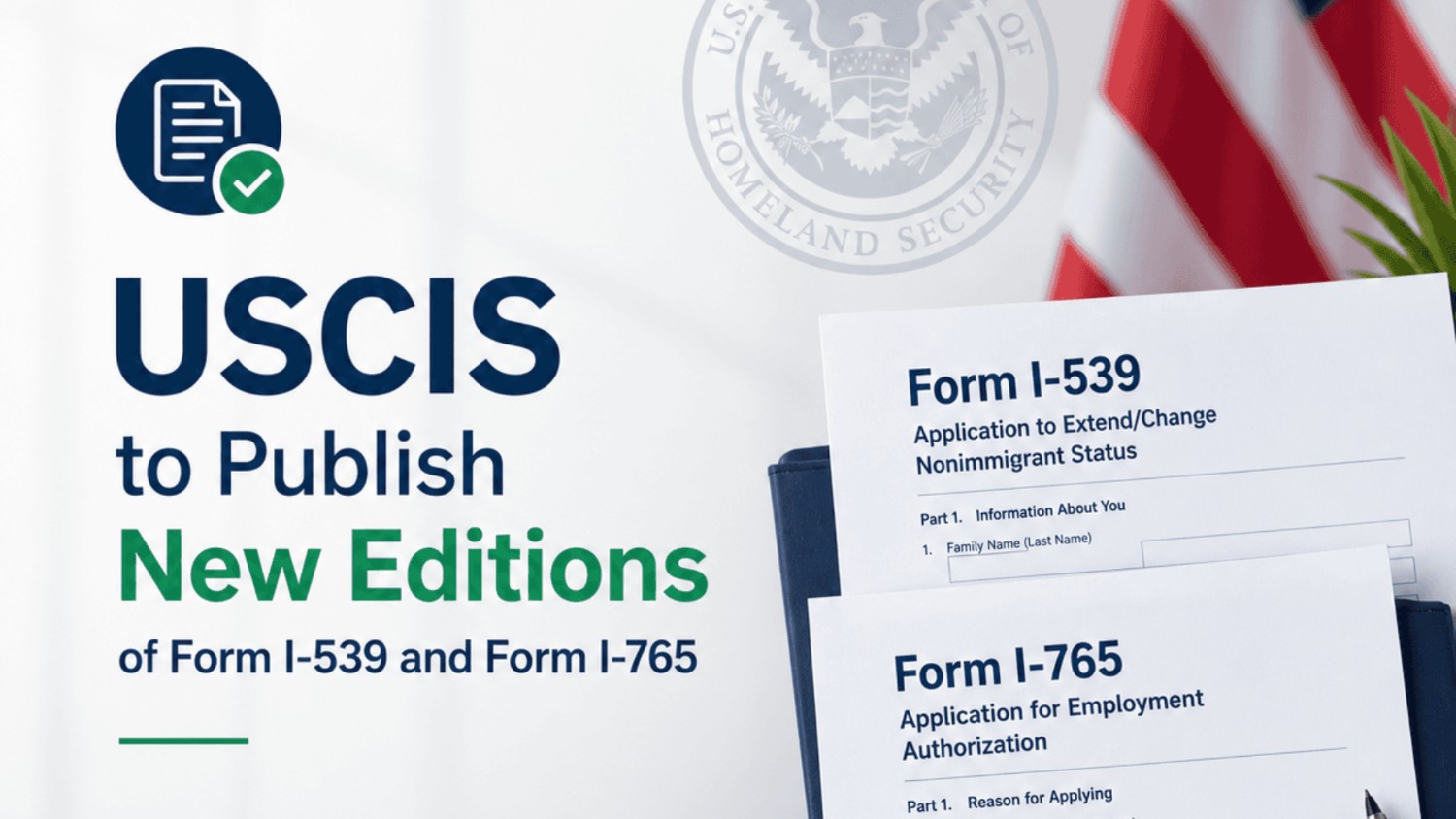
On Sept. 15, 2026, U.S. Citizenship and Immigration Services (USCIS) will publish revised editions of two widely used immigration forms:
- Form I-539, Application to Extend/Change Nonimmigrant Status
- Form I-765, Application for Employment Authorization
Both revised forms will have the same edition date: 09/15/26.
These updates are not just routine formatting changes. USCIS revised the forms to align with a recently published final rule titled Establishing a Fixed Time Period of Admission and an Extension of Stay Procedure for Nonimmigrant Academic Students, Exchange Visitors, and Representatives of Foreign Information Media. Because the revised editions are needed to apply the final rule, USCIS is implementing them with no grace period.
That “no grace period” part matters a lot in practice. A form that was accepted the day before can be rejected the next day, even if everything else in the filing is correct.
Below is a clear breakdown of what these forms are, what they do, and what is changing starting Sept. 15, 2026.
Table of Contents
What Form I-539 is (and what it’s used for)
Form I-539 is the application used by certain nonimmigrants to:
- Extend a current nonimmigrant stay, or
- Change from one nonimmigrant status to another, when eligible
In plain terms, it is commonly used when someone is lawfully in the United States in a temporary status and needs to ask USCIS for more time, or needs to move into a different temporary category.
Examples of situations where Form I-539 is commonly involved include:
- An individual seeking an extension of stay in a visitor category (such as B-1/B-2) when permitted
- A dependent spouse or child in a derivative status (often listed as a dependent classification) applying to extend along with the principal
- A person requesting a change of status from one nonimmigrant classification to another, when allowed under the rules for that category
The key point is that Form I-539 is about maintaining lawful nonimmigrant status through an extension or change, not about permanent residency.
What Form I-765 is (and what it’s used for)
Form I-765 is the application used to request an Employment Authorization Document (EAD), often referred to as a work permit.
The EAD is proof of authorization to work in the United States for certain categories of applicants, depending on the underlying immigration status or pending application.
Form I-765 is commonly used by people who are eligible to work because of:
- A specific nonimmigrant status that allows employment authorization through USCIS approval
- A pending immigration application that provides eligibility to apply for an EAD
- Certain special categories recognized in the regulations (the eligibility category is selected on the form)
While the form itself is the same, eligibility depends entirely on the category being requested and whether the person meets the requirements at the time of filing.
What USCIS is changing on Sept. 15, 2026
USCIS will publish new editions of both forms on Sept. 15, 2026, with edition date 09/15/26.
These new editions will replace:
- Form I-539 (08/28/24 edition)
- Form I-765 (08/21/25 edition)
USCIS updated the forms to match the requirements of the final rule addressing fixed time periods of admission and extension of stay procedures for certain nonimmigrants, including:
- Nonimmigrant academic students
- Exchange visitors
- Representatives of foreign information media
The practical effect is that USCIS needs certain updated information and formatting on the forms in order to process cases under the new rule. That is why USCIS is not offering a transition period.
There is no grace period for these new form editions
USCIS has specifically stated there will be no grace period for the revised editions of Form I-539 and Form I-765.
That means:
- Starting Sept. 15, 2026, USCIS will reject older editions if they are submitted on or after that date.
- The new editions will only be accepted if the filing is postmarked or electronically submitted on or after Sept. 15, 2026.
So the timing splits very cleanly into “before Sept. 15” and “on or after Sept. 15.”
One more detail that matters: USCIS is providing preview versions of the new 09/15/26 editions with instructions ahead of time, but the preview forms are not meant to be filed early.
Important: Do not file the 09/15/26 editions before Sept. 15, 2026
Even though USCIS is making preview versions available, USCIS has said not to file the 09/15/26 editions before Sept. 15, 2026.
USCIS will only accept the 09/15/26 editions if they are:
- Postmarked on or after Sept. 15, 2026, or
- Electronically submitted on or after Sept. 15, 2026
So there is a narrow but important point here:
- Filing the “old” form too late leads to rejection.
- Filing the “new” form too early also leads to rejection.
The edition date and the submission date have to match the USCIS acceptance window.
What this means in real filings
In many cases, Form I-539 and Form I-765 are time sensitive. They are often filed to avoid a lapse in status, to request an extension before an I-94 expiration, or to maintain work authorization eligibility where permitted.
Because USCIS will reject the wrong edition after Sept. 15, 2026, the filing plan needs to account for:
- The edition date printed on the form (usually at the bottom of the page)
- The postmark date (for paper filings) or the electronic submission date (for online filings)
- Whether the filing is intended to be “before Sept. 15” or “on or after Sept. 15”
This is one of those changes where a rejection can happen even when the application is otherwise complete, the fee is correct, and the supporting documents are included.
Where to find the preview versions of the new forms
USCIS is providing preview versions of the 09/15/26 editions of both forms, along with their instructions, on the official USCIS form pages:
- Form I-539 webpage
- Form I-765 webpage
These previews are meant to help prepare for the new requirements and reduce last minute confusion, especially since there is no grace period.
Bottom line
USCIS will publish new editions of Form I-539 and Form I-765 on Sept. 15, 2026 (edition date 09/15/26) to align with a final rule affecting certain nonimmigrants, including academic students, exchange visitors, and foreign media representatives.
The older editions will be accepted only if submitted before Sept. 15, 2026, and will be rejected if submitted on or after that date. The new editions cannot be filed early, and will only be accepted if submitted on or after Sept. 15, 2026.
For any case involving an extension, change of status, or employment authorization filing around this date, the form edition and the submission timing will matter as much as the rest of the packet.
Related Posts