For many families, the I‑601A provisional unlawful presence waiver is the key to fixing an immigration situation without years of separation. It lets certain immigrant visa applicants ask USCIS in advance to forgive their unlawful presence before they leave the United States for a consular interview abroad. Lunel Law, an Atlanta‑based immigration firm focused on green cards, citizenship, family immigration, consular processing and waivers, regularly guides immigrants and refugees through this process nationwide.
Table of Contents
Quick snapshot: what the I‑601A does (and doesn’t) do
| Topic | What the I‑601A does | What it does not do |
|---|---|---|
| Main purpose | Provisionally waives the unlawful presence ground of inadmissibility under INA 212(a)(9)(B) for certain immigrant visa applicants. | Does not waive other inadmissibility grounds (criminal, fraud, health, etc.). |
| When it’s used | Filed while you are in the U.S., before departing for your immigrant visa interview abroad. | Not used after a consular officer finds you inadmissible for multiple grounds—that’s usually Form I‑601. |
| Status in the U.S. | Does not give lawful status, protection from removal, or work/travel authorization while pending or after approval. | You remain subject to removal and cannot work unless you have a separate work-authorized status or EAD. |
| Effect on green card | If approved and no other inadmissibility is found, it clears the unlawful presence bar so a consular officer can issue an immigrant visa. | Does not guarantee a green card; you must still be otherwise admissible and complete consular processing successfully. |
What is the I‑601A provisional unlawful presence waiver?
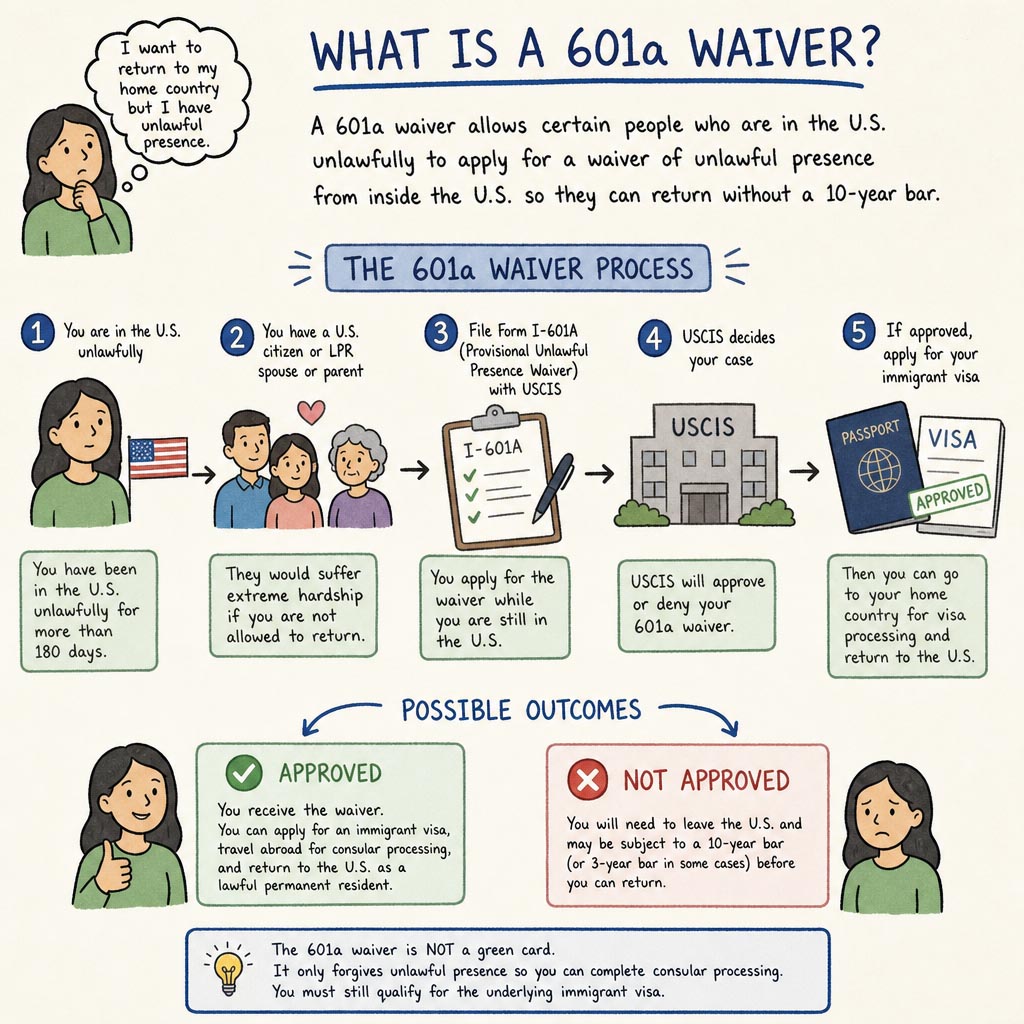
The I‑601A is a standalone USCIS form that lets certain immigrant visa applicants ask for a provisional waiver of the “3‑year” and “10‑year” unlawful presence bars before traveling abroad for their consular interview. It is limited to people whose only ground of inadmissibility is unlawful presence under INA 212(a)(9)(B).
USCIS designed the provisional waiver process to reduce the time U.S. citizen and lawful permanent resident (LPR) family members are separated from their relatives while those relatives finish consular processing outside the United States. If granted, the waiver becomes effective only after you depart, attend the visa interview, and a consular officer confirms that unlawful presence is the only inadmissibility ground being waived.

I‑601A vs. I‑601: key differences
Who qualifies for an I‑601A? (2026 eligibility overview)
USCIS and official instructions set out who may file Form I‑601A. In simple terms, you must:
- Be physically present in the United States when filing and when you attend biometrics.
- Be at least 17 years old at the time of filing.
- Have an approved immigrant visa petition (family‑based, employment‑based, certain special immigrant, or Diversity Visa selection).
- Have a pending immigrant visa case with the Department of State (DOS) and have paid the visa fee.
- Believe you are or will be inadmissible only for unlawful presence (3‑year or 10‑year bar).
- Be able to show extreme hardship to a qualifying U.S. citizen or LPR spouse or parent if you are refused admission.
Eligibility checklist table
| Requirement | Yes/No check | Notes |
|---|---|---|
| Physically present in the U.S. when filing and for biometrics | ☐ Yes / ☐ No | Required; USCIS will deny if you are outside the U.S. |
| Age 17+ at time of filing | ☐ Yes / ☐ No | Under‑17 applicants are ineligible. |
| Approved immigrant visa basis (I‑130, I‑140, I‑360, or DV selection) | ☐ Yes / ☐ No | Immediate relatives, family preference, employment, certain special immigrant or DV. |
| DOS case open and immigrant visa fee paid | ☐ Yes / ☐ No | The NVC case/IV fee bill must be paid before filing I‑601A. |
| Only inadmissible for unlawful presence (no other grounds) | ☐ Yes / ☐ No | Other inadmissibility (e.g., crimes, fraud) generally makes you ineligible. |
| Qualifying relative (U.S. citizen or LPR spouse or parent) | ☐ Yes / ☐ No | Hardship must be to this qualifying relative. |
| Extreme hardship evidence available | ☐ Yes / ☐ No | Medical, financial, psychological, country condition evidence, etc. |
Because the eligibility rules are technical, Lunel Law typically starts with a detailed intake to confirm that the I‑601A is the right strategy and to catch other possible inadmissibility issues early.
Who is not eligible? Common I‑601A ineligibility situations
USCIS instructions highlight several categories of people who cannot get a provisional unlawful presence waiver. You are not eligible if, for example:
- You are subject to a final order of removal, exclusion, or deportation and do not already have an approved Form I‑212 (permission to reapply).
- You are in removal proceedings that are not administratively closed, or proceedings that were closed but have been placed back on the immigration court’s calendar.
- You need a waiver for other inadmissibility grounds besides unlawful presence (e.g., certain crimes, fraud/misrepresentation, certain security or health grounds).
- You are already scheduled for an immigrant visa interview and did not act in time to file an I‑601A before the interview was scheduled, subject to limited exceptions.
For anyone with prior deportations, arrests, immigration fraud, or multiple unlawful entries, Lunel Law generally recommends a personalized legal analysis before deciding whether to pursue I‑601A or a different waiver path.
Evidence and “extreme hardship”: what USCIS is looking for
The heart of a strong I‑601A case is extreme hardship to a qualifying U.S. citizen or LPR spouse or parent if your waiver is denied and you cannot lawfully return to the United States for many years. USCIS looks at the totality of circumstances, not just one factor—your case is judged on how the hardships combine and how severe they are.
Common hardship themes include:
- Serious medical conditions of the qualifying relative and need for your care or income.
- Significant financial impact, such as loss of a primary breadwinner, unmanageable debt, or inability to meet housing and basic needs.
- Educational and developmental disruption, especially if your qualifying relative or their children have special needs or are mid‑degree.
- Country conditions in the country of relocation (e.g., violence, lack of medical care, discrimination, economic collapse).
- Psychological/emotional hardship from long‑term separation or forced relocation to a dangerous or unfamiliar country.
Lunel Law’s waiver practice focuses on building detailed narratives and gathering supporting documents—medical records, expert reports, financial documents, psychological evaluations, and country‑condition evidence—to present a cohesive extreme‑hardship story rather than just a stack of papers.
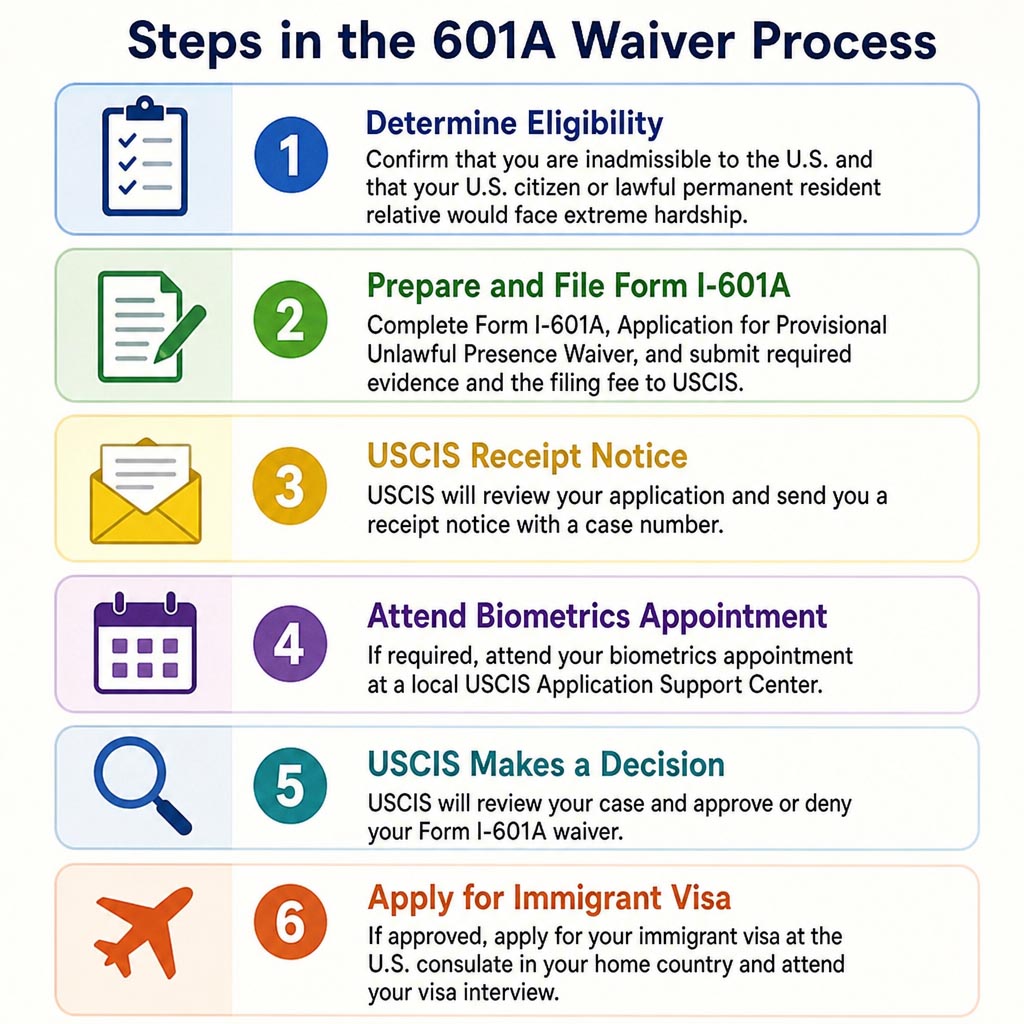
Step-by-step I‑601A process (2026 overview)
While each case is unique, the typical flow looks like this:
- Immigrant petition approved
A family member or employer files and wins approval of Form I‑130, I‑140, or I‑360, or you are selected in the Diversity Visa program. - National Visa Center (NVC) case and IV fee
The State Department opens your immigrant visa case and issues the immigrant visa fee bill, which must be paid before filing I‑601A. - Confirm I‑601A eligibility
You and your attorney verify that unlawful presence is the only ground of inadmissibility and that you have a qualifying relative and hardship evidence. - Prepare and file Form I‑601A
- Complete Form I‑601A in black ink or using the USCIS fillable PDF.
- Include supporting documents, fee payment, and cover letter.
- File as a standalone application; it cannot be filed together with other forms.
- As of 2026, I‑601A must be mailed to the USCIS Chicago Lockbox; it is not available for online filing.
- Biometrics appointment
After receipt, USCIS issues a notice for you to provide fingerprints, photo, and signature at an Application Support Center (ASC) in the U.S. - USCIS decision (approval / RFE / denial)
USCIS may send a Request for Evidence (RFE) or decide based on the record. - Consular processing abroad if approved
If the waiver is approved, you complete NVC processing, then depart the U.S. for your consular interview abroad; if no new inadmissibility is found, the consular officer can issue your immigrant visa.
Throughout this process, Lunel Law emphasizes planning around family needs, timing travel carefully, and minimizing the period of separation after the waiver is approved.
I‑601A fees and other costs (2026)
Publicly available 2026 practice resources and fee updates show the following typical government fees related to an I‑601A‑based consular case (not including attorney’s fees):
Government fee table (approximate, 2026)
Because USCIS regularly adjusts filing fees, Lunel Law always confirms the current official fee on the USCIS I‑601A page and fee schedule before filing.
Processing times in 2026: how long does an I‑601A take?
Actual I‑601A processing times in 2026 vary widely and have been trending long. Recent practice‑based sources report ranges from roughly 9–12 months up to 26–32 months, depending on the time period and how the data is measured. Some analyses of USCIS data show provisional waivers taking around 26.5–32 months from filing to decision, while others report national averages around 9–13 months at certain service centers.
Because the numbers shift frequently, the safest approach is:
- Check the USCIS “Check Case Processing Times” tool for Form I‑601A and the current service center.
- Add extra time for possible RFEs and for NVC consular scheduling after approval.
- Plan your family, work, and travel around a realistic multi‑year timeline, not a best‑case scenario.
USCIS does not offer premium processing for Form I‑601A, and paying more money cannot buy faster adjudication. Limited expedited processing based on humanitarian or compelling circumstances may be requested but is rarely granted and is evaluated case‑by‑case.
Common I‑601A denial reasons and how to avoid them
Practice materials and community experience reveal several recurring reasons why I‑601A applications are denied:
- Insufficient extreme hardship evidence
Applications that consist of only a few brief letters and generic claims of sadness or financial difficulty often fail to meet the “extreme hardship” standard. - Other inadmissibility issues
If USCIS believes you may be inadmissible for other reasons (crimes, fraud/misrepresentation, prior removal orders, certain immigration violations), they can deny the provisional waiver. - Inaccurate or incomplete information
Leaving questions blank, inconsistently reporting immigration or criminal history, or failing to sign the form properly can lead to denial or rejection. - Not meeting standalone and procedural rules
Filing I‑601A together with other forms, filing while outside the U.S., or filing when removal proceedings are active and not administratively closed are classic pitfalls.
Lunel Law combats these risks through meticulous form review, detailed hardship declarations, and careful screening for hidden inadmissibility before preparing the waiver package.
Does an approved I‑601A guarantee a green card or legal status?
No. Even if USCIS approves your I‑601A, you do not gain lawful status, work authorization, or travel permission inside the United States. You remain subject to removal, and you generally cannot work without a separate Employment Authorization Document (EAD) or work‑authorized status.
An approved I‑601A simply means that, if unlawful presence is your only inadmissibility ground, that bar will be provisionally waived when you leave for your consular interview and you are otherwise eligible for an immigrant visa. The consular officer must still verify that no new inadmissibility issues exist and that all other visa requirements are satisfied before issuing the visa.
Form I‑601A explainer: part-by-part walkthrough
Below is a plain‑language explainer based on the current 9‑page Form I‑601A (edition 01/20/25) you attached. This is meant to help readers understand what each section is asking for—not to replace the official instructions or personalized legal advice.
Overview table: I‑601A parts and purpose
Part 1 – Information About You
Part 1 collects your core identity, contact, and immigration‑history information. You provide your A‑Number (if any), Social Security number (if any), full legal name, other names used, and your U.S. mailing and physical addresses.
This section also asks for your date of birth, city and country of birth, and citizenship, plus detailed history of your last and prior entries into the United States, including dates, place of entry, and status at entry. A critical set of questions asks whether you are in removal proceedings, have a final order, have been granted voluntary departure, or have ever been arrested, cited, or convicted for any crime.
Practice tip:
- Answer every question fully and truthfully, and use Part 9 to explain any arrests, deportation history, or complicated entry patterns; misstatements can hurt credibility more than the underlying issue.
- If you ever received an approved Form I‑212 after a removal order, list that receipt number accurately.
Part 2 – Biographic Information
Part 2 asks about your ethnicity, race, height, weight, eye color, and hair color. These details are used for identity verification and background checks and should match other immigration records and identity documents where possible.
Part 3 – Information About Your Immigrant Visa Case
Here you tell USCIS how you are immigrating. You select whether your immigrant visa basis is:
- Diversity Visa Program
- Immediate relative (I‑130)
- Family preference (I‑130)
- Employment‑based (I‑140)
- Certain special immigrant/widow(er) (I‑360)
You then provide your DOS DV case number or NVC immigrant visa case number, USCIS receipt number for the approved petition, and the full name of the petitioner (family member or employer).
Practice tip:
- Make sure your DOS and USCIS case numbers match exactly the notices you’ve received; small errors here can cause delays or confusion at NVC.
Part 4 – Information About Your Qualifying Relative
This part focuses on the spouse or parent who would suffer extreme hardship if your waiver is denied. You enter their full name and indicate whether they are a U.S. citizen spouse, U.S. citizen parent, LPR spouse, or LPR parent.
If you have more than one qualifying relative (for example, both a U.S. citizen spouse and an LPR parent), you can list another one and must provide proof of their status as well.
Practice tip:
- Make sure the people you list here are truly “qualifying relatives” for I‑601A purposes (USC or LPR spouses/parents); hardship to children can still be relevant but must typically be linked to hardship on the qualifying spouse or parent.
Part 5 – Statement From Applicant
Part 5 is where you explain, in your own words, why USCIS should approve your provisional waiver as a matter of discretion. The form specifically invites you to describe the extreme hardship your qualifying relatives would experience if you were refused admission.
Practice tip:
- Treat this as the core of your case: explain two scenarios—(1) if your relative has to relocate abroad with you, and (2) if your relative stays in the U.S. while you remain abroad—and detail the hardships in both.
- Lunel Law typically supports this narrative with organized exhibits (medical records, financial statements, psychological evaluations, expert country‑condition reports) and a structured declaration drafted with attorney assistance.
Part 6 – Applicant’s Statement, Contact Information, Declaration, Certification, and Signature
In Part 6, you confirm whether you read and understood the form in English or via an interpreter and whether a preparer helped you. You provide your phone number, email address, and then sign under penalty of perjury that the information is complete, true, and correct.
USCIS emphasizes that you must appear for biometrics and will be required to reaffirm your answers under oath.
Practice tip:
Part 7 – Interpreter’s Contact Information, Certification, and Signature
If someone interpreted the form for you, this part captures their name, address, contact information, and a certification that they are fluent in English and your language. They must sign and date the form.
Part 8 – Preparer’s Contact Information, Declaration, and Signature
If anyone other than the applicant filled out the form (including an attorney), they are listed here, with their contact information and a certification about how they prepared the form. Attorneys may also need to file a separate Form G‑28.
Part 9 – Additional Information
This is extra space to continue answers from earlier sections—for example, to list additional prior entries, arrests, or to give more context to complex questions. You can make copies of this page or attach separate sheets, but each must list your name, A‑Number, the corresponding page/part/item numbers, and include your signature and date.
Practice tip:
- Use Part 9 strategically to provide clear timelines (immigration history, criminal history, prior applications), often in chart form, so adjudicators can easily follow your story.
Examples of strong I‑601A waiver themes
Real‑world practice and training materials show that successful I‑601A cases usually demonstrate layered hardships, not just a single problem.
- Medical hardship: Qualifying spouse has a serious condition (e.g., cancer, heart disease, complex pregnancy, mental health disorder) and depends on your physical and emotional support, with U.S.‑based specialists hard to replace abroad.
- Financial hardship: You are the primary breadwinner, and without your income the family cannot maintain housing, repay debts, or pay for crucial medical care or education.
- Educational disruption: Qualifying relatives or children are in specialized programs or at critical stages in school; relocation would cause major setbacks or loss of special‑education services.
- Country conditions: The country of return has high violence, political instability, or severe lack of medical care, making relocation dangerous or unrealistic for your qualifying relative.
- Psychological hardship: Separation triggers or worsens depression, anxiety, PTSD, or other mental‑health issues in the qualifying relative, documented by a licensed professional.
Lunel Law works with clients to identify and document these themes thoroughly so that USCIS sees the full human impact, not just a list of facts.
How Lunel Law helps with I‑601A waivers
Lunel Law is a U.S. immigration firm dedicated to immigrants and refugees, with a focus on lawful permanent residency (green cards), nationality law, family petitions, consular processing, and waivers. The firm regularly appears before immigration authorities and courts nationwide and has specific experience with provisional unlawful presence waivers as part of consular processing strategies.
In a typical I‑601A case, Lunel Law can:
- Evaluate whether the I‑601A is the right tool, or whether other waivers or strategies are needed (for example, when crimes, fraud, or prior removal orders are involved).
- Build a custom hardship narrative, including detailed declarations from you and your relatives and supporting documentation.
- Coordinate with medical, psychological, or country‑conditions experts when appropriate.
- Prepare and file the I‑601A package, respond to USCIS RFEs, and guide you through consular processing after approval.
If you are considering an I‑601A waiver, a consultation with an experienced attorney can help you avoid costly missteps and assess the true risks and benefits of this path.
FAQs about the I‑601A waiver in 2026
1. What is the current government filing fee for Form I‑601A?
Recent 2026 practice sources report a USCIS filing fee of $795, plus an $85 biometrics fee for most applicants between ages 14 and 79, for a typical total of $880 paid to USCIS. Because USCIS periodically changes fees and may bundle or separate biometrics costs, always confirm the latest amount on the official I‑601A page or fee schedule before filing.
2. How long does an I‑601A waiver take in 2026?
Different practice‑based reports give different ranges, but overall, applicants in 2026 should prepare for long waits—often from about 10–12 months up to 2–3 years. The exact timeline depends on USCIS workload, service center, whether you receive an RFE, and other system backlogs, so checking the USCIS processing‑time tool for Form I‑601A is essential when planning.
3. Can I work legally while my I‑601A is pending?
No, Form I‑601A by itself does not provide work authorization, lawful status, or protection from removal. To work lawfully, you must have a separate work‑authorized status or an Employment Authorization Document (EAD) based on another application (such as a pending adjustment of status or another eligible category).
4. Can I travel outside the U.S. while my I‑601A is pending?
If you depart the United States while your I‑601A is pending, USCIS will generally treat the application as abandoned, and leaving may trigger or activate the unlawful presence bar you were seeking to waive. The provisional waiver process is designed for applicants who remain in the U.S. until the case is decided and then depart for a scheduled consular interview.
5. Do I have to leave the U.S. if my I‑601A is approved?
Yes. An I‑601A approval does not allow you to adjust status inside the United States; you still must depart for your immigrant visa interview at a U.S. consulate or embassy abroad. If the consular officer confirms that unlawful presence is your only inadmissibility ground and that you otherwise qualify, they can issue you an immigrant visa, and you become a permanent resident when you re‑enter the U.S. using that visa.
6. Can I file Form I‑601A online?
As of 2026, Form I‑601A cannot be filed online; it is a paper application that must be mailed to the USCIS Chicago Lockbox. After the Lockbox receives the paper form, USCIS scans it and adjudicates it electronically, but the initial filing remains mail‑only.
7. Is there premium processing for I‑601A? Can I pay extra to speed it up?
No. USCIS does not offer premium processing for Form I‑601A, and there is no paid fast‑track option. Standard processing times apply to all applicants, though in limited situations you or your attorney can request an expedite based on specific humanitarian or public‑interest criteria, which USCIS reviews at its discretion.
8. What happens if my I‑601A is denied?
If USCIS denies an I‑601A, the waiver is simply not granted, and you generally remain in the same immigration situation you were in before filing. You do not automatically get placed into removal proceedings, but denial can carry risks for people who already have complicated immigration histories, so strategic planning with an attorney is important before re‑filing or pursing other options.
9. Can I apply for I‑601A if I previously had a removal order?
If you are subject to a final order of removal, exclusion, or deportation, you are usually ineligible for a provisional unlawful presence waiver unless you first obtain an approved Form I‑212 (permission to reapply for admission) from USCIS. Even with an approved I‑212, these cases are complex and should be evaluated carefully by experienced counsel.
10. Does hardship to my children matter if they are not qualifying relatives?
While U.S. citizen or LPR children are not “qualifying relatives” for I‑601A statutory purposes, their hardship is still important indirect evidence of hardship to your qualifying spouse or parent. For example, a child’s serious medical or educational needs can significantly increase the mental, financial, and logistical burden on your qualifying relative, and USCIS may consider these factors in the overall extreme‑hardship analysis.
11. Do I need a lawyer to file an I‑601A?
USCIS does not require you to have a lawyer, but the law and strategy around waivers, extreme hardship, and inadmissibility are complex and highly discretionary. Because an I‑601A often involves long processing times and major life consequences, many applicants choose to work with a firm like Lunel Law that regularly handles consular processing and waivers and can help build a robust, well‑documented case from the start.
Important disclaimer: This blog is for general informational and guiding purposes only and does not create an attorney–client relationship or substitute for individualized legal advice. Every case is different. For a personalized assessment of your immigration options, consider scheduling a consultation with an experienced immigration attorney at Lunel Law.
Related Posts